

How to Use Semrush for Keyword Research: A Step-by-Step Guide
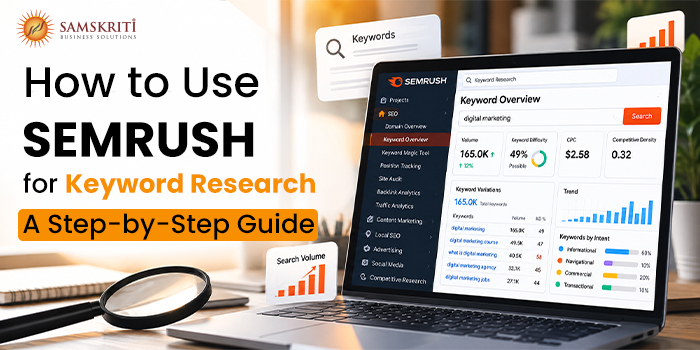
Keyword Research is the foundation of Search Engine Optimization. And for most traditional SEO companies, keyword research begins and, unfortunately, ends with Keyword Planner, which is a mistake.
Using Google Keyword Planner for SEO Is Like Using a Screwdriver to Pick a Lock
It is not just a limited tool; in fact, it is the wrong tool. Keyword Planner was built around Google Ads. So, every metric in it- competition, volume, or CPC is calibrated around Google Ads, not SEO.
“There is no way for anyone to break out of the rut of search engine obscurity if the foundations are wrong or, say, not aligned. Choosing the right keywords that align with your goal, budget, and timeline is half the work in SEO, and no tool on the market does it better than SEMrush,” says one of the senior SEO specialists at Samskriti Business Solutions.
We know this is hardly an insight; any serious SEO analyst already knows SEMrush’s overarching power for keyword research.
So, this blog isn’t for them. It is for folks who want to know how to do keyword research with Semrush while also understanding how its features sharpen your SEO game.
And then we are going to let you know the dealbreaker with Semrush that may obstruct you from using its potential and also give a way to bypass it and leverage it for your SEO success. Read on.
How to Perform Keyword Research in Semrush: A Step-by-Step Guide
Step 1: Keyword Magic Tool
Every project starts in the Keyword Magic Tool, with a broad term related to your business.
- Drop the broad term in the Keyword Magic Tool, and Semrush pulls all the relevant keyword terms from its database of 23 billion keywords and instantly groups them into sub-topics on the left.
- Pricing Questions, comparisons, how-to searches, branded keywords, long-tail keywords – everything falls into place instantly, grouped into categories and subtopics with exact search volume.
Spend a few minutes scrolling through them and getting a feel for the topics, subtopics, and clusters. And you don’t need to sort them; they are already sorted. Now let us narrow our search down.
Step 2: Volume + Keyword Difficulty
- Set a Keyword Difficulty range that fits your site. If it’s a small or new website, stay under a keyword difficulty of 30-40.
- Add a minimum volume that makes sense for your market. There is no specific minimum number for search volume, as it depends on the nature of the business and local intent in the searches.
And it goes without saying – don’t chase big numbers if you can’t win them.
Takeaway – Sort keywords by volume, then filter by Keyword Difficulty, and save the keywords that clear both filters.
Step 3: Search Intent Tags
Semrush categorizes every keyword into Informational, Navigational, Commercial, and Transactional buckets, and this tag tells you what the person actually wants when they type it.
Without this intent filtering, you may end up writing a blog post for someone ready to buy or spend days building a sales page for someone who wants to learn and research about a generic product category – both activities waste time and resources.
Also, manually sorting the intent at this stage is in no way practical and could take days depending on the volume of keywords you are targeting, and Semrush gives them instantly.
Takeaway – Sort your keyword list by intent. Put buy-intent keywords on product and service pages, and learning-intent keywords go to blog content.
Step 4: Find Those Keyword Gaps with Competitor Intelligence
Now that we have a preliminary list backed by knowledge of our own services, audiences, and goals, in this step, let us look outward for inspiration not just from anyone – but from your main competitors.
Put in two or three competitor domains, and Semrush shows you every keyword your competitors rank for that you don’t. This not only gives you more keyword ideas but gives you a real-time picture of where you stand and what you are missing – a triple treat that no other tool delivers.
Takeaway – Filter for “Missing” and “Weak” keywords. Sort by volume. Add the strong ones to your list.
Step 5: Organic Research for Top Pages of Competitors
Not just keywords, but you can even go one level deeper in competitor research.
Open Organic Research, then look at a competitor’s Top Pages to find the single pages that bring in the most traffic for your competitors. Now you know exactly which page to study, and which page of your own deserves the most effort.
Step 6: Topic Research + Question Keywords
The last stage is dedicated to understanding long-tail keywords and the intent of the users:
Open Topic Research, or use the Questions filter inside Keyword Magic Tool, and you’ll get real questions people type with natural, exact phrasing.
These ‘search phrases’ turn your keyword list into an actual content calendar that you can center your content marketing around without any guesswork.
Semrush gives you 360-degree capabilities and features you wouldn’t even know exist. If you are a small and medium business owner who is aiming to rescue your website from the rut of obscure search pages in a short time, Semrush is a no-brainer,” says a senior SEO analyst at Samskriti Business Solutions, a leading SEO company in Hyderabad. But there is only one caveat – the price of a Semrush subscription.
Beat the Cost: How to Leverage Semrush’s Full Power on a Budget
If you are in a highly competitive industry where organic search is the meat and potatoes of your strategy, then there is a high chance that Semrush is the primary driver of your competition, and with free tools, you are only falling behind in the game.
So, if you are a small or medium business owner looking to leverage Semrush’s full potential to level up your SEO game, the only feasible way to beat the cost is to hire an expert SEO agency built around powerful, premium tools like Semrush.
Given the steep price of Semrush, you can easily hire the right SEO agency that provides affordable SEO services in Hyderabad powered by premium Semrush, and here’s the thing – they deliver results in a short time.
At Samskriti, we specialize in SEO for small and medium businesses and lead the market in delivering high-ROI SEO services powered by Semrush, Brightedge, Ahrefs, and 20+ cutting-edge SEO tools, with dedicated SEO teams for businesses across all verticals.